The Jewish Community of Budapest
Budapest
The capital of Hungary, became a city in 1872, following the union of the historic towns of Buda, Obuda, and Pest.
CONTEMPORARY BUDAPEST
Approximately 80,000 to 100,000 Jews live in Hungary, making it central Europe's largest Jewish community. More than 80% of Hungarian Jews live in the capital city of Budapest. Smaller Jewish communities can be found in the neighboring areas of Debrecen, Miskolc, Szeged and Nyiregyhaza. Of the ten thousand Holocaust survivors living in Hungary, the vast majority live in Budapest. Since 2013, hundreds of Jews have left Hungary due to a rise in anti-Semitism, many of whom then settled in Vienna. The traditional Jewish Quarter of Budapest is located in District VII. Within it are several Jewish historical sites, stores and kosher restaurants.
Following the collapse of communism in 1989, several Jewish organizations were reopened. The largest organization serving the Jewish community of Budapest is MAZSIHISZ, the Federation of Jewish Communities in Hungary. A variety of social services are provided by the Joint Distribution Committee, as well as the Lauder Foundation. Healthcare and medical services are provided by the Charity Jewish Hospital and Nursing Facility and two centers for elderly care. The city's many religious institutions include a historic mikvah (ritual bath) and a variety of kosher restaurants. Budapest also has over ten kosher butcher shops, bakeries, and even a matza factory.
Each year Budapest hosts several Jewish social and cultural events. The Jewish Summer Festival puts on a variety of shows including concerts, dance performances, and films. The Jewish community has also established many social and educational programs for children and young adults. The most popular organizations are B'nei Brith, WIZO, UJS, Bnei Akiva, and the Maccabi athletic club. Each summer, an estimated 1,500 campers from more than twenty countries attend Camp Szarvas.
Since the fall of communism, there has been a revival of Jewish religious life in Budapest. As of the beginning of the 21st century, there are as many as twenty synagogues throughout the city, representing a variety of movements including Orthodox, Chabad Lubavitch, Neolog (similar to the Conservative Movement) and Liberal. There are also synagogues located in the provincial cities of Miskolc and Debrecen. In 2003, Slomo Koves became the first Orthodox rabbi to be ordained in Hungary since the Holocaust.
Budapest boasts many Jewish kindergartens, elementary schools, and high schools. The three Jewish high schools are Lauder Javne, Wesselenyi, and Anna Frank. Lauder Javne is located on a five-acre campus and was opened in 1990. It is non-denominational and is sponsored by the Ronald S. Lauder Foundation. The Budapest University of Jewish Studies was established in 1877 as a Neolog Rabbinical seminary. Jewish studies programs are offered at several universities including Eotvos Lorand University, the largest school of higher education in Hungary, the Hungarian Academy of Sciences, and the Central European University which was established by Hungarian-born George Soros. Jewish educational programming is also offered at the Beth Peretz Jewish Education Centre Foundation, the American Foundation School, and the Hillel Jewish Educational and Youth Center.
The capital city of Budapest is rich with culture and history, and is home to several buildings, monuments, and cultural centers, including several points of Jewish interest. One such place is the Holocaust Memorial Center, which commemorates the victims of the Holocaust during World War II. The Center is situated outside the traditional Jewish quarter and is housed by the Pava Synagogue where it has been since 2004. In 2005, the institution was awarded the Nivo Prize of Architecture for the restoration and rehabilitation of a historic monument.
The city's Jewish Museum is the second-largest in all of Europe. It operates under the auspices of the Alliance of Jewish Communities in Hungary. In 1942, two employees hid valuable museum artifacts in the cellar of Budapest's National Museum. During the German occupation, the building served as an escape passage as its gate was situated outside the borders of the ghetto. Additionally, Theodor Herzl was born in the building which once stood at the present site of the museum.
One of the most significant Jewish cultural sites in Budapest is the Emanuel Holocaust 'Tree of Life' Memorial sculpture in Raoul Wallenberg Park. Engraved on the thirty thousand leaves are the names of Jews who were killed or had disappeared during the Holocaust.
Two other important sites which memorialize the victims of the Holocaust and the events of World War II are the statue of Raoul Wallenberg and the Shoes on the Danube Embankment. Raoul Wallenberg was a Swedish diplomat who saved many Jewish lives by helping them escape deportation. The Shoes on the Danube Embankment is a memorial comprised of sixty pairs of metal shoes set in concrete. Created in 2005, it commemorates the Hungarian Jewish victims killed by militiamen of Arrow Cross, the pro-German national socialist party which was active in Hungary between 1944 and 1945.
In addition to cultural centers and memorials, Budapest contains a number of Jewish landmarks. Located in the heart of Budapest is the King's Hotel –one of the first private Jewish three-star hotels in Budapest. While the hotel has been renovated and modernized, the building itself is more than one hundred years old.
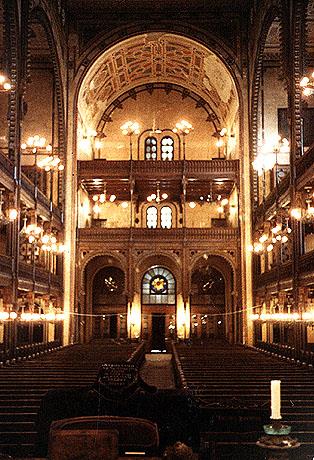
Northern Budapest contains the Medieval Jewish Chapel, a small Sephardic house of prayer which had been rebuilt from ruins in the 18th century. During the 1686 siege of Budapest many of the city's Jewish buildings were completely destroyed. The chapel's original function was not revealed until an excavation in the 1960s when the synagogue's keystone and tombstones engraved in Hebrew were unearthed. Another historic religious site is the Dohany Street Synagogue. Inaugurated in 1659, the synagogue is designed in a Moorish style and is the second-largest synagogue in the world.
Still serving the Jewish community of Budapest is the Kozma Street Cemetery. It is the largest Jewish cemetery in Budapest, and among the largest in Europe. Its unique monuments and mausoleums have drawn many visitors since it opened in 1891.
There are three major publications which serve the Jewish community of Budapest and Hungary. The biweekly Uj Elet (New Life) is the official journal of MAZSIHISZ; the Szombat (Saturday) provides news and information about Jewish life in Hungary as well international issues, and the Mult es Jovo (Past and Future) is a cultural and intellectual journal.
HISTORY
BUDA (also known as Ofen, Oven, Boden, Bodro)
The first Jewish settlers came to Buda from Germany and various Slavic countries during the second half of the 12th century. In 1279 they were isolated in a ghetto, and forced to wear a red badge. Over the course of the 14th century, the Jewish community was expelled twice: first in 1349 following anti-Semitic allegations that arose after the Black Death had swept through the region, and again in 1360 as a result of hostility from the church. In 1364 Jews were permitted to return, though with some restrictions imposed on them. After the establishment of Buda as the royal residence in the late 14th century, its Jewish community became prominent within the larger Hungarian Jewish community. During the 15th century, the Jewish community was recognized as an autonomous government, and the community leader of Buda became the leader of Hungarian Jewry at large. At this time, the Jews of Buda were mainly engaged in commerce and in exports to the German lands and Bohemia.
In 1526 the Turks captured Buda. The majority of the Jews, about 2,000 people, were expelled to the Ottoman Empire, while a minority escaped to communities in western Hungary which had not fallen to the Turks. Jews were able to resettle Buda in 1541 and despite the heavy taxes, the community grew and became the wealthiest and most important in Hungary. Jews occupied influential positions in the management of the treasury and were generally employed in commerce and finance. By 1660 the Ashkenazi and Sephardi communities numbered about 1,000 Jews.
In 1686, the Austrians and their allies conducted a siege of Buda and subsequently defeated the Turks and conquered the town. The Jewish population had sided with the Turks and nearly half of them perished over the course of the fighting and its aftermath. The Jewish Quarter was ransacked, and the Torah scrolls were set on fire. Half of the remaining Jews, approximately 250 people, were taken as prisoners and exiled. These events are mentioned in Megilat Ofen, by Yitzhak ben Zalman Schulhof.
The new Austrian administration, in response to church demands, placed restrictions upon the Jews and the Jewish community was consequently subject to more restrictions and expulsions. The Jews of Buda were exiled in 1746 by Empress Maria Theresa, and were permitted to return in 1783, when Emperor Josef II allowed the Jews to reenter and settle in Hungarian towns. The community did not regain its former stature and prominence until the second half of the 19th century, at which time there were 7,000 Jewish families living in Buda.
During these turbulent times, Buda saw the formation of a number of Jewish institutions and the rise of several prominent figures. The latter half of the 18th century saw the establishment of a Hevra Kadisha. By 1869 four synagogues had been built, and were joined by two more at the end of the 19th century. The first known rabbi of the community was Akiva Ben Menahem Hacohen, also called "Nasi," who led the community during the 15th century. In the second half of the 17th century, during the lifetime of Rabbi Ephraim Ben Yaakov Hacohen, Buda was a focal point of the messianic movement of Shabbetai Zvi in Hungary. Moshe Kunitzer, a pioneer of the Haskalah movement in Hungary, was the chief rabbi from1828 until 1837.
OBUDA (also known as Alt-Ofen in German, and Oven Yashan, Old Buda, in Hebrew)
The Jewish community in Obuda vanished after the Turkish conquest in 1526 and was not resettled until 1712, under the leadership of Yaakov Lob. After the return of the Jewish community, by 1727 there were 24 Jewish families living in Obuda under the protection of the counts of Zichy. In a document recognized by the royal court in 1766, the Jews were granted freedom of religion, trading rights relating to the payment of special taxes, and permission to live anywhere in the town. This was a privilege granted in Obuda only.
The Jews of Obuda practiced agriculture, commerce and various trades. Textile factories established by the Jews of Obuda, among them the Goldberger Company, enjoyed favorable reputations throughout Hungary.
The first synagogue was built in 1738, a Hevra Kadisha was founded in 1770, and a Jewish hospital was established in 1772. In 1820 The old synagogue of Obuda underwent significant renovations. That same year, The Great Synagogue on Lajos Street was consecrated, and became one of the most well-known synagogues in the Habsburg Empire. Additionally,during the year 1820 an ultimately short-lived school was built at the demand of Emperor Josef II; since, however, Jewish parents did not want Christian teachers educating their children, the school was consequently closed. However, in spite of these impressive community projects, by the middle of the 19th century many Jewish families were moving to Pest.
PEST
Jews are first mentioned as living in Pest in 1406, and in 1504 there is mention of several Jewish home and landowners. Yet after the Austrian conquest in 1686 Jewish settlement in Pest ended. Although some sources mention a sporadic Jewish presence in Pest, it was not until 1746, when Jews expelled from Buda were looking for alternate places to live, that Jews once again began living in Pest in significant numbers. This community, however, was officially recognized only in 1783, when Emperor Josef II began allowing Jews into Hungarian towns, though they had to pay a special "tolerance tax" to the town. The first synagogue was opened in 1787 in Kiraly Street and later several more synagogues were built, including a Sephardi synagogue. The Great Synagogue on Dohany Street, which remains one of the largest in Europe, was built later, in 1859.
After the emperor’s death in 1790, limitations on Jewish settlement were re-imposed, and only a few Jews chosen by the town’s authorities were permitted to remain in Pest. The rest moved into the Erzsebetvaros Quarter, which maintained a large Jewish population until the Holocaust. During this period, the Jews set up factories and were engaged in commerce and trade.
In spite of the reimposition of restrictions on the Jewish community, they nonetheless were able to open the first Jewish school in Pest, in 1814. This school taught both religious and secular subjects in German. Additionally, there were several private Jewish schools. In later years, a girls’ school was opened in 1814 and a Jewish Teachers' training college was opened in 1859. The Orthodox community opened its first school in 1873.
The restrictions imposed after the death of Emperor Josef II were repealed in 1840. During the Hungarian National Revolution of 1848-1849, also known as the Revolution of Liberty against the Habsburg rule, many of the Jews from Pest volunteered to fight, and the community contributed considerable sums of money to the revolution. When the revolution failed, however, heavy taxes were imposed upon the Jews of Pest because of their participation. In 1867, following the formation of the dual monarchy of Austria-Hungary, the new Hungarian government granted equal rights to the Jews of Hungary. This prompted a fruitful period of community-building; that same year the Jewish community of Pest opened an orphanage for girls, the first of its kind in Hungary, followed by a second orphanage for boys in 1869. In later years, several hospitals and welfare institutions for the elderly and sick were opened, as well as a home for the deaf and dumb, which was inaugurated in 1876.
Judaism was officially recognized as one of the accepted religions of Hungary in 1895.
The year 1867 also saw a new initiative from the Pest community: The Hungarian Jewish Congress. Its aim was to prompt a discussion of the schisms in the Jewish community, particularly between the Orthodox and the Neolog congregations. Following the first meeting of the congress in December 1868, the Orthodox appealed to the Hungarian government and in 1871 they were legally recognized as a distinct community. In 1889 Rabbi Koppel Reich was elected to be the head of the Hungarian Orthodox community; he later became a member of the upper house of the Hungarian parliament in 1927, when he was nearly 90 years old.
In 1877, the Rabbinical Seminary was opened in Budapest. Its aim was to integrate rabbinical studies with general education, and it became one of the world’s leading institutions for rabbinical training. Its founders and faculty members were well-known researchers and instructors. The seminar’s publications included journals such as the Magyar Zsido Szemle (Hungarian Jewish Review). In spite of opposition and boycotts from the Orthodox community, the seminary played a central role in shaping modern Hungarian Jewry.
BUDAPEST
In 1873, Buda and Pest were officially merged with Obuda, creating the city of Budapest. Concurrently, the second half of the 19th century was a period of economic and cultural prosperity for the Jewish community of Budapest. The beginning of the 20th entury saw Budapest become an important center for Jewish journalism. The weekly Magyar Israelita became the first Jewish newspaper in Hungarian. In the broader community, Jews also assumed an important role in the founding and editing of leading newspapers in Hungary, such as Nyugat (West). During the interwar period, non-Orthodox Jewish educational institutions included 15 schools with 3,600 students. Meanwhile, the Orthodox community had a population of approximately 10,000 and was establishing its own welfare and educational institutions.
1919-1921 was the period of The White Terror in Hungary. After the fall of the short-lived Hungarian Soviet Republic, the new regime of Admiral Miklos Horthy organized army gangs to suppress and destroy any lingering communist elements in the country. Because a number of the communist leaders were Jewish, Hungarian Jews became the main victims of this “purification." From the time Admiral Horthy entered Budapest on November 14, 1919, Jewish officials in the army and government service were dismissed, Jews were forbidden to trade in tobacco and wine, and scientific institutions were closed to them. In 1920, the Numerus Clausus law was imposed, which determined admission to universities on a national basis and effectively established a quota for the number of Jews permitted to enter Hungarian universities.
In spite of government-endorsed anti-Semitism and anti-Semitic violence, by 1935 there were 201,069 Jews living in Budapest making it one of the largest Jewish communities in the world.
BUDAPEST JEWS OF NOTE
• Ignaz Goldziher (1850-1921), the founder of the Academy for the Study of Modern Islam. He was the secretary of the Budapest Neolog community from 1874 to 1904. Goldziher helped found the Jewish-Hungarian Literary Society which worked to spread Jewish culture by means of lectures and publications. Among the Society's publications was the first Jewish translation of the Bible into Hungarian. Goldziher also founded the Jewish-Hungarian museum. He was a teacher in the Rabbinical Seminary of Budapest.
• Arminius Vambery (1832-1913), a famous traveler and researcher. He was instrumental in introducing Theodor Herzl to the Sultan of Turkey.
• Ferenc Molnar (1878-1931), an outstanding dramatist and novelist. Molnar is best known today as the author of the famous children’s book The Paul Street Boys, published in 1927.
• Lengyel Menyhert (1880-1974 ), a dramatist and scriptwriter. His credits include Ninotchka (1940) and To Be or Not to Be (1942), celebrated films for which he wrote the screenplays.
• Professor Alexander (Sandor) Scheiber ( 1913-1985) was the director of the Rabbinical Seminary during the 1950s. He published research on the history of Hungarian Jewry, and in his last years was actively involved in the consolidation of communal life in Budapest.
ZIONISM
Budapest was the birthplace of Theodor (Binyamin Ze'ev) Herzl (1860-1904), the father of modern Zionism. The writer and physicist Max Nordau (1849-1932), a founding member of the World Zionist Congress and author of the Basel Platform at the First Zionist Congress (1897), was also born in Budapest. It is not surprising, therefore, that Budapest was a hotbed of Zionist activity at the turn of the 20th century. In 1903 the student Zionist association Makkabea was established; its first group of pioneers immigrated to Palestine before the end of World War I.The Zionist press in Budapest began in 1905 with the publication of Zsido Neplap (Jewish Popular Paper), which closed down two years later. Magyar Zsido Szemle (Hungarian Jewish Review), another Zionist publication, began operating in 1911, the same year as the quarterly Mult es Jovo.
The Zionist activity in Budapest was strengthened by the arrival in the city in 1940 of Zionist leaders from Transylvania, among them Rudolf Kasztner (who would later play a controversial role during the Holocaust) and Erno Marton. The worsening situation of the Hungarian Jewry during the late 1930’s and during the Holocaust period led to a rise in the popularity of Zionism.
Another Budapest Zionist of note is Hanna Szenes (1921-1944), a native of Budapest who emigrated to Palestine. Szenes was a poetess and paratrooper in the Haganah an underground Jewish military organization in Palestine. During World War II, Szenes was sent on a mission to Hungary to help organize Jewish anti-Nazi resistance. Tragically, she was captured and executed by the Nazis.
Although Zionist organizations reemerged and were active after World War II, the Communist regime banned their activities after 1949, and a number of Zionist leaders were put on trial having been accused of “conspiracy”.
THE HOLOCAUST
Following the Discriminatory Laws of 1938-41, which limited Jewish participation in the economy and society, certain large institutions and factories were required to dismiss their Jewish employees. In 1940, Jews began to be drafted to be forced laborers, which meant that many families were left without any means of support. On November 20, 1940, Hungary signed a treaty with Italy and Japan, thereby officially joining the Axis Powers led by Nazi Germany. During the period that followed Hungary's entry into the war against the Soviet Union in 1941, until the occupation of Hungary by the German army on March 19th, 1944, more than 15,000 Jews from Budapest were killed during deportations and in forced labor camps.
In March 1944, Adolph Eichmann ordered that the Jewish communal organizations be dissolved, and replaced by a Jewish council, Zsido Tanacs. Jews were forced to wear the yellow badge. Freedom of movement was restricted and many buildings were seized. The licenses of Jewish lawyers and newspapers were suspended. On June 30, 1944, the Germans started to concentrate the Jews in certain parts of the city and plans were made to begin their deportation.
The anti-Semitic Arrow Cross Party, led by Ferenc Szalasi, came to power in October 1944. The new government immediately began carrying out attacks against the Jews, killing 600 people during the first days. Papers and certificates that could allow Jews to stay and work in the city were no longer valid. On October 20th 1944 Eichmann ordered that all men aged 16-60 were to be sent to dig fortifications against the approaching Soviet army. 50,000 men marched on that Death March. Three days later the women and children were forced to join the men. These Jews were later transferred by the Germans at the border station at Hegyeshalom. The remaining Jews were concentrated into two ghettos.
At the end of December 1944 there were about 70,000 people in the central ghetto in Budapest; tens of thousands of others found shelter in the international ghetto, where diplomats of neutral nations, such as Carl Lutz of Switzerland and Raoul Wallenberg of Sweden, were issuing protective papers for Jews. Zionist organizations also forged documents in order to save Jews. The number of protective certificates, legal and forged, issued in Budapest was around 100,000; meanwhile, approximately 2,748 Jews were hidden in monasteries and in church cellars. By the time the Soviet army entered and occupied the city on January 17th, 1945, 76,000 Jews were handed over to the Germans, a number which includes victims of deportation and death marches. At the end of World War II there were approximately 90,000 Jews in Budapest. Meanwhile, over 100,000 Jews from Budapest, a majority of the population, perished.
THE COMMUNIST REGIME
After the Holocaust, many survivors emigrated to Palestine. Others remained in Hungary, where a large number abandoned the Jewish tradition and identity, either due to their traumatic experiences during the war, or due to the influence of the atheist government in Hungary. In 1956, after the Hungarian anti-Soviet uprising, about 25,000 Jews left the city.
During the communist period, the Jewish community of Budapest was controlled by the Department of Religious Affairs within the Ministry of Internal Affairs. Starting in1968, each of the 18 administrative districts of Budapest contained at least one synagogue, a rabbi, a Talmud Torah, and a lecture hall. Additionally, there was a Jewish high school in the capital, with a student population of about 140 and the Orthodox community founded a yeshiva with 40 students. The Rabbinical Seminary, which was reconstructed after the war and was the only institution of its kind in any communist country, continued to be active thanks to the support of the Neolog movement.
Uj Elet (New Life), was a biweekly newspaper published by the Budapest Jewish community which reflected the changing ways in which the Jews of Hungary understood their identity. Other Jewish communal services included a Jewish hospital, an old age home, a kosher restaurant, the availability of kosher meat, and a matza bakery.
George Charles de Hevesy (1885-1966), chemist, isotopes pioneer, and Nobel Prize winner, born in Budapest, Hungary (then part of Austria-Hungary), to a Roman Catholic family of Hungarian Jewish descent. He studied in Budapest and in Freiburg. In 1908, after obtaining his doctorate at Freiburg, he worked with Lorenz at the Technische Hochschule in Zurich, Switzerland, with Haber at Karlsruhe, and with Rutherford in Manchester, England. In 1913 he started to work with F. Paneth in Vienna, Austria, on radioactive isotopes. This was the beginning of the use of radioactive tracers or "labeled atoms," an important tool in chemical and biological research. When World War I broke out in 1914, Hevesy joined the Austro-Hungarian army as technical supervisor of the state electrochemical plant in the Carpathians. After the war he returned to Budapest and during the revolution of 1918-19 he resumed his studies of isotope tracers.
In 1920 he joined Niels Bohr at the new institute of theoretical physics in Copenhagen. There, together with D. Coster, he discovered a new element, no. 72, which he called hafnium. In 1923 he revealed in a paper the first use of radioactive tracers in a biological problem and in 1924 their first use in animal physiology. In 1926 Hevesy became professor at Freiburg, Germany; there he added a new field – X-ray fluorescence – as a method of analysis of trace materials in minerals, rocks, and meteorites.
In 1930 to 1931 Hevesy was one of the two George Fischer Baker Non-Resident Lecturers in Chemistry at Cornell University, in Ithaca, N.Y. He lectured on analysis by means of X-ray, the discovery and character of hafnium, and the chemical composition of the earth and the comic abundance of the elements.
In 1934 he was forced to resign from his position at Freiburg on account of his Jewish origins and returned to the Copenhagen institute. The discovery of artificial radioactive elements immensely enhanced the utility of the tracer technique in research work. After 1938 Hevesy gave his whole attention to the use of this tool in biochemical research. When Copenhagen was no longer safe he escaped to Sweden where he continued his work. In 1943 he was awarded the Nobel Prize "for the use of isotopes as tracers in the study of chemical processes." After World War II, Hevesy remained in Stockholm, Sweden, as professor in the institute of organic chemistry of the university. His biological work continued, largely on nucleic acids, the metabolism of iron and calcium, cancer anemia, and effects of radiation. Among Hevesy's other awards and honors were the "Pour le Merite" from the German president Heuss and the Atoms for Peace Award (New York, 1959).
His major published works are: "Recherches sur les proprietes du hafnium" (1925); "A Manual of Radiactivity" (co-author, Fritz Paneth, two additions); "Das Alter der Grundstoffe" (1929); "Chemical Analysis by X-Rays and Its Applications" (1932; translated also into Russian, 1935); "Artificial Radioactivity of Scandium" (1935); "Action of Neutrons on the Rare Earth Elements" (Hilde Levi, co-author, 1936); "Excretion of Phosphorus" (Ladislau Hahn and O. Rebbe, co-authors, 1939).
Elemer Hantos (1881-1942), economist, born in Budapest, Hungary (then part of Austria-Hungary). He studied law and economics at the universities of Budapest, Leipzig, Germany, and Cambridge, England. From 1904 he was editor of "Penzugyi Szemle" (Financial Review).
Upon returning to Hungary, he was appointed by the government to assist with the programme for reorganizing the banks. This reform led to the establishment of the National Association of Banks and the National Old Age Pension Institution of Banks. From 1910 to 1918 he was a deputy in the Hungarian Lower Chamber, and published several books dealing with the credit system and Hungarian financial legislation. In 1916 he became undersecretary of state in the Ministry of Commerce, and subsequently associate professor of finance at the University of Budapest. In 1918 he was appointed president of the Royal Hungarian Postal Savings Bank which afterf the break-up of the Austro-Hungarian Empire served as the Hungarian Central bank for a short time. His published works during the years 1916 to 1918 deal with the monetary and economic problems caused by the First World War.
In 1919 he left public life to devote himself to supporting Hungary's programme for the restitution of its historic frontiers and believed that an economic federation of the Danubian countries might eventually lead to political union under Hungarian leadership. This plan was embodied in "Magyarorszag gazdasagi integritasa" (1933). According to Jacques Droz in his book Europe Centrale “it was Hantos who through the economic institutes which he founded in Vienna, Budapest, Brno and Geneva created the idea of a central European. In 1930 he helped to found the Central European Study Centre at the University of Geneva, Switzerland. He was responsible for founding the "Mitteleuropaische Wirtschafstagung", and the “Danubian League” . He organized several international conferences to promote the idea.
While in Cambridge he published "The Magna Charta of the English and Hungarian Constitutions" (1904), a comparative study of the two oldest written constitutions in Western civilization. During the period between the two world wars Hantos published some 30 books concerning monetary issues, economic policies, agriculture and transportation. He devised a plan to improve rail and water transportation in central Europe. Many of these works were translated into several languages. His aim was to probe the economic problems of Central Europe in a rational manner, and to as a result to build a feasible plan for the economic reconstruction of these countries.
In 1924 Hantos was appointed an economic consultant to the League of Nations. He wrote several books in Hungarian on the functions of money in the disrupted economics of post-war Europe. These were followed by others in German and French, among them "La monnaie, ses systemes, et phenomenes" (1925), also several works on the economic problems of the world, including "L'economie mondiale et la Societe des Nations" (1930); "Die Rationalisierung der Weltwirtschaft" (1930); "Die Kooperation der Notenbanken" (1931); "L'Europe comme unite economique" (1932). Works by Hantos dealing with the problems of Central European problems include: "L'Europe Centrale" (1932); "Der Weg zum neuen Mitteleuropa" (1933); "Die Neuordnung des Donauraumes". (1935).
Born of Jewish parents, Hantos converted Christianity.
Felix Philipp Kanitz (1829-1904), ethnographer and art historian, born in Pest (now Budapest), Hungary (then part of the Austrian Empire). He studied history, archeology and ethnography at various universities in Austria, Germany and France. He traveled throughout Serbia, Bulgaria and other Balkan countries in order to investigate relics of the Roman and Byzantine empires there. Later he became interested in the history and cultures of the peoples who had lived in the Balkans after the disintegration of these empires.
Kanitz published his findings in "Die Roemischen Funde in Serbien" (1861); "Serbiens Byzantinische Monumente" (1862); "Reise in Suedserbien und Nordbulgarien" (1878); "Serbien, historisch-ethnographische Reisestudien aus den Jahren 1859-1868" (1868); "Donau-Bulgarian und der Balkan" (1875-79); "Roemische Studien aus Serbien" (1892); "Katechismus der Ornamentik" (1902); "Das Koenigreich Serbien" (1904).
Kanitz, who converted to Christianity at some time in his life, died in Vienna in 1904.
Dezso Raskai (born Desider Reach) (1866-1944?), urologist, born in Budapest, Hungary (then part of the Austrian Empire) who studied at the Universities of Budapest and Vienna. Raskai became lecturer (Privatdozent) at the University of Budapest and physician-in-chief of the urology divisions of several hospitals in Budapest. His numerous works were published both in Hungarian and in German. They include: "A cystitis aetiologiaja" (1900); "A hugycsoszukuletek korszovettana" (1901); "Az eromuvi hugycsoszukuletek" (1908); "Tanulmanyok a dultmirigy megnagyobbodasarol" (1901-1905); "Vesevizsgalati modszerek" (1911); "Ueber Harnroehrenstrikturen" (1912); "Die Rolle des Influenzabazillus bei Erkrankungen der Urogenitalapparate" (in "Virchow's Archiv", 1913); "Metschnikoff-tanulmany" ("Metchnikoff Study", 1932); "Az urologia magyar uttoroi" ("Hungarian Pioneers of Urology", 1933). Raskai converted to Christianity.
Mihaly Michael Polanyi (Pollacsek)(1891-1976), scientist, born in Budapest, Hungary (then part of Austria-Hungary). He studied at the technical schools of Budapest and Karlsruhe, Germany, and became a lecturer (Privatdozent) at the technical school of Berlin in 1923.
In 1929 he was made a life member of the Kaiser Wilhelm Institut fuer physikalische Chemie, but in 1933 he lost this position, partly as a result of his protest against the introduction of the racial question in the evaluation of scientific achievement. In the same year he went to England where he became professor of physical chemistry at Victoria University, Manchester, and later at Oxford. Polanyi also made a diagrammatic film, "Money and Unemployment" (1939).
In addition to a number of articles on plasticity, crystal structure, absorption and chemical reaction, he published "Atomic Reactions" (1932); "USSR Economics" (1935). In the latter book as well as in "The Contempt of Freedom" (1940) he touched upon questions outside his proper field of research. In his "A magyar forradalom uzenete" ("The Message of the Hungarian Revolution") he raised his voice for freeing from jail freedom fighters of the 1956 Hungarian Revolution.
Tivador Nachez (1859-1930) Violinist and composer. Born in Pest, Hungary, as a boy he played with Franz Lizst and studied with Joachim in Berlin. In 1889 he settled in London and embarked on a career as a violin virtuoso.
His compositions include Danses Tsiganes; Concerto for violin and orchestra; and a string quartet. Nachez edited Vivaldi's violin concertos in A minor and G minor. He died in Lausanne, Switzerland.
Lipot Osztern (1872-1944), lawyer, born in Budapest, Hungary (then part of Austria-Hungary). He was a brother of Salamon Pal Osztern, a renown orientalist. He gained a lawyer's diploma at the Academy of Sciences of Budapest. In 1916 the Royal Court of Budapest appointed him as official translator of German, Hebrew and "Jargon" (Yiddish) languages.
From 1920, L. Osztern served as president of the Hungarian Zionist Association. For nine years he was a member of the representative committee of the Jewish Community of Pest, and was a board member of several religious, charity and cultural organizations.
Osztern contributed to the "Zsido Szemle" and "Mult es Jovo" periodicals.
Bela Szenes (Schlesinger) (1894-1927), author, born in Budapest, Hungary (then part of Austria-Hungary). He joined the editorial boards of various newspapers, and was noted for his feuilletons, known as "Szenes-ember," which in Hungarian, has the additional meaning of "coalman".
In his short life he was a gifted and prolific writer. His stories include: "A Szenes ember konyve" ("The Story of the Coalman", 1916), "A kristof-teri Kolumbusz" ("Columbus of Kristof-square", 1918); "Pest" (1919); "Csibi" ("Two Young People", 1919); Vidam irasok ("Humorous Writings," 2 vols., 1920-21); "A tizenegyedik parancsolat" ("The Eleventh Commandment", 1921); "Aladar" (1921); "Gyurika" (1921), "Tizenharmadikan penteken" ("On Friday the 13th", 1922).
Szenes wrote humorous plays, which were successful on the Hungarian stage and also abroad. Among his plays were: "A buta ember" ("The Stupid Man", 1921), "A gazdag leany" ("The Rich Girl", 1921); "Holdvilag" ("Moonlight", 1924); "Az alvo ferj" ("The Sleeping Husband", 1926), and "Nem nosulok" ("I Won't Marry", 1927). In 1924, Szenes wrote 20 one act plays.
Bela Szenes was the father of World War II heroine Hanna Szenes.
Manfred Weiss de Csepel (1857-1922), industrialist, born in Pest, Hungary (then part of the Austrian Empire, now Budapest in Hungary). Weiss - together with his brother, Berthold - founded the first canning factory in Hungary. This was later converted into the armaments factory at Csepel. It could supply all the armaments needs of the Hapsburg Empire and during World War I had 8,000 workers. After the War, Weiss manufactured household appliances, agricultural machinery and motorcars. He founded the National Union of Hungarian Industrialists and was also active in the Jewish community.
Caroline (Karoline) Bettelheim-Gompertz (1845-1925), pianist and opera-singer, born in Budapest, Hungary (then part of the Austrian Empire). Her younger brother is the literature critic and journalist Anton Bettelheim. She studied piano under Karl Goldmark and her voice coach was Moritz Laufer. She first appeared on the stage as a pianist at the age of 14, and two years later she sang with the Imperial Opera of Vienna, Austria, with whom she signed a contract. She sang in most of the major opera houses of Germany and in London, England. Caroline Bettelheim married Julius Ritter von Gomperz (1824-1909), who served as President of the Austrian Chamber of Commerce.