The Jewish Community of London
After the Norman conquest of 1066, a few Jews attracted
by the economic opportunities came over from the adjacent areas of the
continent (duchy of Normandy, including Rouen) and established themselves in
London. The earliest recorded mention of the London community dates from
the reign of William Rufus (1087-1100), who appears to have favored the Jews
to some extent. In 1130, the Jews of London were accused of killing a sick
man, possibly some sort of blood libel, and were forced to pay an enormous
fine. Intellectual life in the period was sufficiently flourishing to
attract a visit from Abraham Ibn Ezra, who wrote his Iggeret Ha-Shabbat and
his Yesod Mora in London, in 1158. Anti-Jewish feeling manifested itself in
London during the coronation of Richard I (Sept. 3, 1189) and during the
reign of John (1199-1216). The baronial opposition, both in his reign and in
that of his son Henry III (1216-1272), considered the Jews to be royal
financial instruments and maltreated them accordingly. There was a baronial
attack on London Jewry in 1215.
 |
Study Center of the YAKAR educational
foundation,
London, 1983
Beth Hatefutsoth, Visual Documentation Center
Courtesy of Rabbi Michael Rosen, UK
|
|
 |
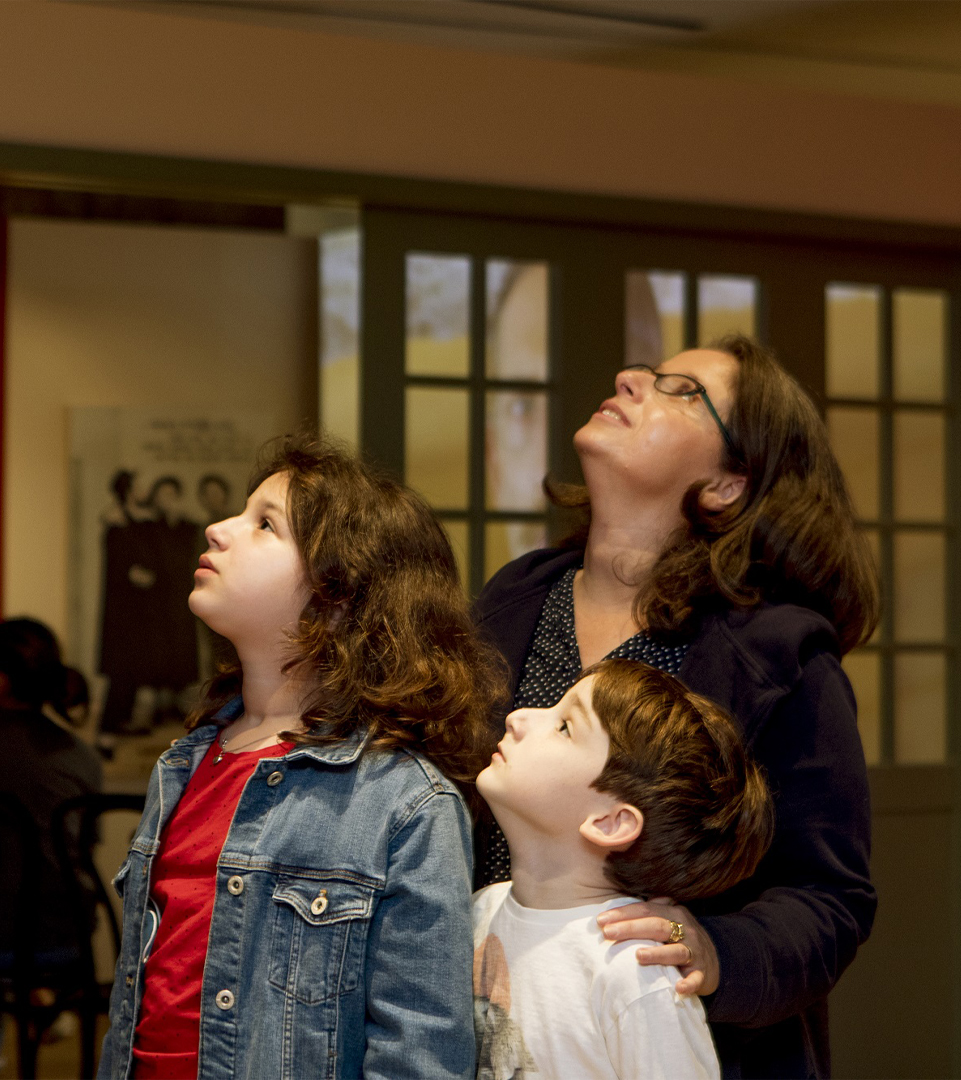
A girl studying the Torah,
London, 1981
Photo: Rachel Rutman, UK
Beth Hatefutsoth,
Visual Documentation Center
Courtesy of Rachel Rutman, UK
|
During the period of maladministration under Henry III,
the Jews of London with those of the rest of the country, were oppressed.
The climax came in 1224, when it was alleged that some gashes found on the
body of a dead child constituted Hebrew characters and the Jews were accused
of ritual murder. This resulted in a savage punitive levy on the Jews. In
1278 a number of London Jews were included in the 680 from all over the
country who were imprisoned in the Tower of London on the charge of clipping
the coinage.
Nearly 300 were said to have been hanged. Theological
odium against the London Jews had been increasing. In 1232, Henry III
confiscated their principal synagogue on the pretext that the chanting could
be heard in a neighboring church.
In 1283 the Bishop of London ordered all the synagogues
in his diocese to be closed, only one being subsequently reopened. Finally,
in 1290, the Jews were expelled from England and the London community ceased
to exist. The number of Jews in London in the Middle Ages probably did not
exceed 500.
In 1409, after the expulsions from Spain and Portugal, a
few Marrano refugees settled in London. At the close of the reign of Henry
VIII, the crypto-Jewish community comprised some 37 households. In 1609 the
Portuguese merchants living in London, who were suspected of judaizing, were
again expelled. Nevertheless, when in 1632 the Marrano community of Rouen
was temporarily broken up, some fugitives, the most important being Antonio
Fernandez Carvajal, found a home in London. Other Marrano settlers went
directly from Spain and Portugal. Thus, when Manasseh Ben Israel went to
England in 1655, there was already established a secret community numbering
several families. A petition was presented to Cromwell asking for protection
(March 1656). A house was rented and adapted for use as a synagogue in the
following December. A few months later, a piece of ground was acquired for
use as a cemetery. After Cromwell's death various attempts were made to
procure the suppression of the community. Charles II, however, intervened in
its favor, and it henceforth enjoyed de facto recognition. The original
synagogue, in Creechurch lane, was enlarged and remodeled in 1674, and in
1701 a new place of worship in Bevis Marks - still one of the architectural
monuments of the city - was erected.
As its spiritual leaders, the newly established community appointed a
succession of foreign Abendana (1681-85), Solomon Ayallon (1689-1701), and
David Nieto (1701-28). There was a considerable influx of Spanish and
Portuguese Jews from Holland. In the course of the reorganization of the
royal exchange in 1697, it was arranged to admit 12 Jews - the so-called
"Jew Brokers" - who remained a feature of the city of London until the
beginning of the 19th century.
Meanwhile, the original Sephardi settlers had been
followed by Ashkenazim who arrived for the most part via Amsterdam or
Hamburg. They organized their own congregation around 1690. The historic
synagogal organization of the metropolis was completed in 1761, when another
rival body, still called the New Synagogue, came into existence. R. Solomon
Hirschell was the first formally recognized Chief Rabbi of the Ashkenazi
communities of the whole of England. The Ashkenazim were by now the most
numerous and influential element in the London Jewish population.
 |
Demonstration in front of
Chabad House, London, 1980
Photo: Rachel Rutman, UK
Beth Hatefutsoth,
Visual Documentation Center
Courtesy of Rachel Rutman, UK
|
|
 |
The tailoring workshop of J.B.
Calmus, London, 1915
Beth Hatefutsoth, Visual Documentation Center
Courtesy of J. Calmus, UK
|
The 19th century was a period of expansion and
reorganization. The first synagogue outside the city had been organized in
Westminster around 1761. The Board for Shechitah, in which Sephardim and
Ashkenazim cooperated, was organized through the offices of Baron Lyon de
Symons in 1792-1804. As early as 1760, the Sephardi community admitted
representatives of the Ashkenazim to their committee of Deputados, appointed
from time to time to represent the community vis-à-vis the government. This
ultimately developed into the Board of Deputies of British Jews, on which
until 1838 only the London communities were represented. The old Talmud
Torah of the Ashkenazi community, established in 1732 and placed on a
broader basis in 1788, was reorganized in 1817 as the Jews' Free School,
originally intended to meet the menace presented by the schools which were
now being set up for Jewish children by Christian missionaries; this
developed in due course in to one of the largest schools in Europe. The
struggle for Jewish emancipation in England centered in London. In 1831,
Jews were given the privilege of trading, from which they
had hitherto been barred. In 1835, David Salomons was elected a Sheriff of
the city, the first Jew to attain that distinction. In 1847, he was the
first Jewish alderman, and in 1855, the first Jewish Lord Mayor of London.
From 1830, the city of London had shown sympathy with parliamentary
emancipation of the Jews, and its persistence in electing Baron Lionel de
Rothschild, notwithstanding the fact that he could not take his seat because
of the form of the statutory oath, was in large measure responsible for the
admission of the Jews to Parliament in 1858.
The growing Anglicization of London Jewry hastened the
reorganization of the community. A reform congregation was established, near
the fashionable centers of population in 1840. To meet this challenge, the
Sephardi and Ashkenazi congregations established branch synagogues in the
West End. A modern theological Seminary, Jews' college, was founded in 1855,
and a model charitable organization, the Board of Guardians for the Relief
of the Jewish Poor, was established in 1859. In 1870, a union of the
principal Ashkenazi congregations in the Metropolis was formed under the
title the "United Synagogue".
With the mass emigration from Russia starting after 1881,
there was a great influx especially to London, and the population rose in
the course of the next quarter of a century from some 47,000 to
approximately 150,000. A majority of the newcomers was absorbed by the
tailoring, shoemaking, and cabinet-making industries. A Yiddish press and an
active trade-union movement came in to being. In 1887, Sir Samuel Montagu
(later Lord Swaythling) created the Federation of Synagogues to coordinate
their religious activities. The Aliens Act of 1905 stemmed the tide of
immigration, though it continued in modified form until the outbreak of
World War I in 1914. The Jew of the East End, as he became more well-to-do,
tended to move away to the newer suburbs , particularly in the North East
(Stamford Hill) and North West (Golders Green), where important
congregations sprang up.
The period between the two wars witnessed a considerable
economic and geographical expansion of London Jewry, as it attained a
greater degree of affluence, extended its interests and hastened the
movement from the traditional center of the East End into the northern
suburbs. A communal center for the major London Jewish Institutions and a
Jewish Museum was established at Woburn House in the Bloomsbury area. The
beginning of the persecutions in Germany in 1933 brought about a
considerable influx of refugees who did a good deal to stimulate certain
aspects of London Jewish life and to consolidate the organization of the
extreme orthodox wing. On the other hand, for a short while, the British
fascist movement under Sir Oswald Mosley led to some anti-Jewish disturbances,
which were however limited in their extent.
The Chief Rabbinate and its Bet Din today administer the
religious life of large sections of provincial Jewry through other Battei
Din and Rabbis. The two leading bodies dealing with religious education, the
London Board of Jewish Education and the Central Council for Jewish
religious education dealing with the provinces, both operate from London.
The pattern was similar in the political and philanthropic spheres. However,
after World War II, and particularly in the 1960s, there was a growing trend
toward decentralization. The total Jewish population of Greater London in
1970 was estimated at 280,000. In 1997, it was estimated at 300,000.
|