|

Synagogues Without Jews
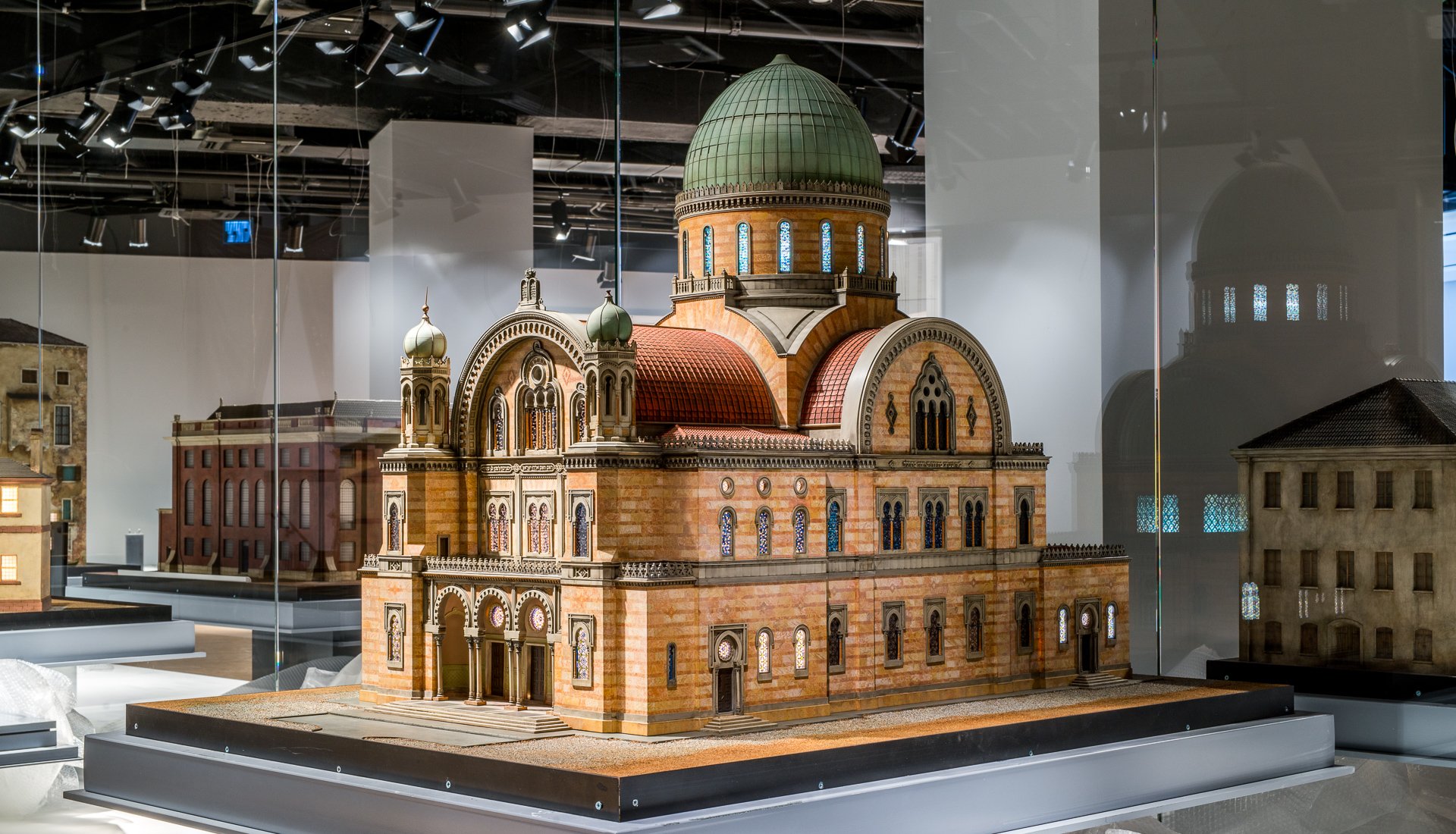
is a new website hosted by Beth Hatefutsoth. Based partly on the book of the
same name by Rivka and Ben-Zion Dorfman (Jewish Publication Society 2000), the
site reviews the local histories of Jewish communities in central Europe and
illustrates aspects of the art and architecture of relatively little known
synagogues.
|

Interior view of the synagogue of Dubrovnik,
Croatia.
The eighteenth-century Aron Kodesh in rich
Baroque style. Three pairs of carved helical pillars, ornamented with narrow
gilded bands and minute Corinthian capitals flank the Ark. The short pillars
rest on raised pedestals, joined to form a gently curved base. Inlaid wood
panels feature stylized floral motifs.
Photo: Rivka and Ben-Zion Dorfman, Israel |

Exterior view of the synagogue of
Halic, Slovakia.
Built in mid-19th century by
the tiny Jewish community of Halic, a village in south central Slovakia, the
synagogue was the tallest building in the village. After World War II, it was
used to store building materials; now it stands empty.
Photo: Rivka and Ben-Zion Dorfman, Israel |
|

Interior view of the synagogue of Szeged,
Hungary
The bronze candelabra were
cast according to Biblical descriptions for the construction of the Temple
utensils. A pair of five branched giant candelabra light up the corners of the
bimah. The seven-branched candelabrum behind them, ornamented with colored
stones, was modeled after the menorah on the Arch Triumph of Titus in Rome.
Photo: Rivka and Ben-Zion Dorfman, Israel |

Interior view of the synagogue of Ancona,
Italy
The Heikhal, as the Holy Ark
is called in the Italian tradition, is embellished on each side with a series of
exquisitely carved pillars of rose marble. Blue marble panels carrying gilded
ornaments separate the pillars of the row at the rear. A parokhet (Holy Ark
curtain) of red damask cloth hides the repoussé silver doors of the Ark.
Photo: Rivka and Ben-Zion Dorfman, Israel |
The goal of bringing
information about vanished communities to the public stretches beyond the
horizon. The hope is that Synagogues Without Jews
will spark the desire to reveal more treasures of the Jewish cultural heritage.
Dozens of volunteers
worked with dedication to create this web site. Some condensed and edited selected
chapters from the book; others translated the stories into Hebrew and European
languages, while several have chosen to engage in new research for later
insertion of more information on the web.
The
Book
Synagogues without Jews
Related Articles
Synagogues around the World
Synagogues
in Germany: A Virtual Reconstruction
Documentation of German and
Austrian Synagogues destroyed by the Nazis
In the Land of Hagar – The
Jews of Hungary, Virtual Exhibition
The Jewish Community of Budapest
The Jewish Community of Dubrovnik
|